
Why Every Executive Needs Trusted Advisors: And Why General counsel Often Don't Have Them
By Jenn Smyth-Whelly, Co-Founder of GC Collective | Business Strategist
When we think about successful executives, we rarely picture them making every important decision alone.
CEOs have boards, mentors, executive coaches, and peer advisory forums. Founders build advisory boards long before their companies reach maturity. CFOs participate in finance leadership networks where they can compare approaches, test ideas, and learn from peers facing similar challenges. Seeking perspective isn't viewed as a weakness - it's considered good leadership.
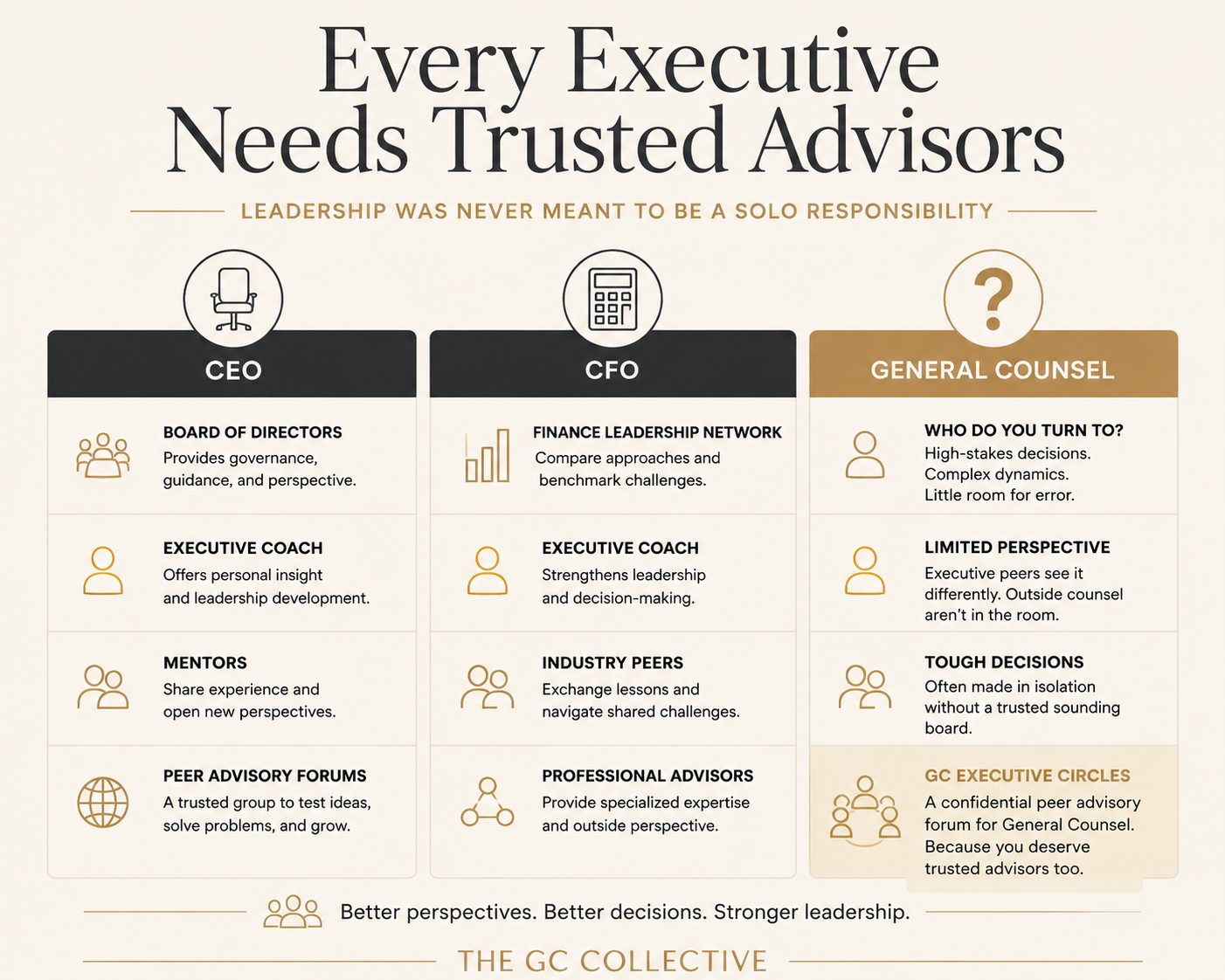
Yet GCs are often expected to navigate some of the most complex leadership decisions in an organization without that same level of support.
The legal questions are rarely the hardest part of the role. The more difficult decisions involve judgment: how to influence a CEO without becoming an obstacle, when to challenge a board, how to lead a growing legal team through change, how to balance risk against business priorities, and how to earn credibility as a strategic partner across the executive team. These are leadership decisions, not legal ones, and they rarely have a single right answer.
What many GCs need isn't another technical course or legal update. They need trusted advisors who understand the realities of the role because they're living it themselves.
Leadership Was Never Meant to Be a Solo Responsibility
The strongest leaders aren't the ones with all the answers. They're the ones who seek out different perspectives before making difficult decisions.
Trusted advisors provide context, challenge assumptions, share lessons learned, and offer the benefit of experience. They help leaders see around corners and navigate situations that don't come with a playbook.
For GCs, finding those advisors can be surprisingly difficult.
Your executive colleagues are approaching challenges from different lenses. Outside counsel serve an important role, but they're not sitting in your executive meetings or managing your legal department. Your own team may not be in a position to challenge your thinking or appreciate the competing pressures you face.
Sometimes the most valuable perspective comes from another GC who has already wrestled with the same issue.
A Different Kind of Leadership Development
That belief is what led us to create the GC Collective Executive Circles.
Rather than following a predetermined curriculum, each Executive Circle brings together a carefully curated cohort of GCs and CLOs who collectively shape the conversations around the leadership challenges they're facing in real time. Facilitated by Paula Pepin and Jenn Smyth-Whelly, the program creates space for honest discussion, thoughtful reflection, and practical problem-solving in a confidential setting built on trust.
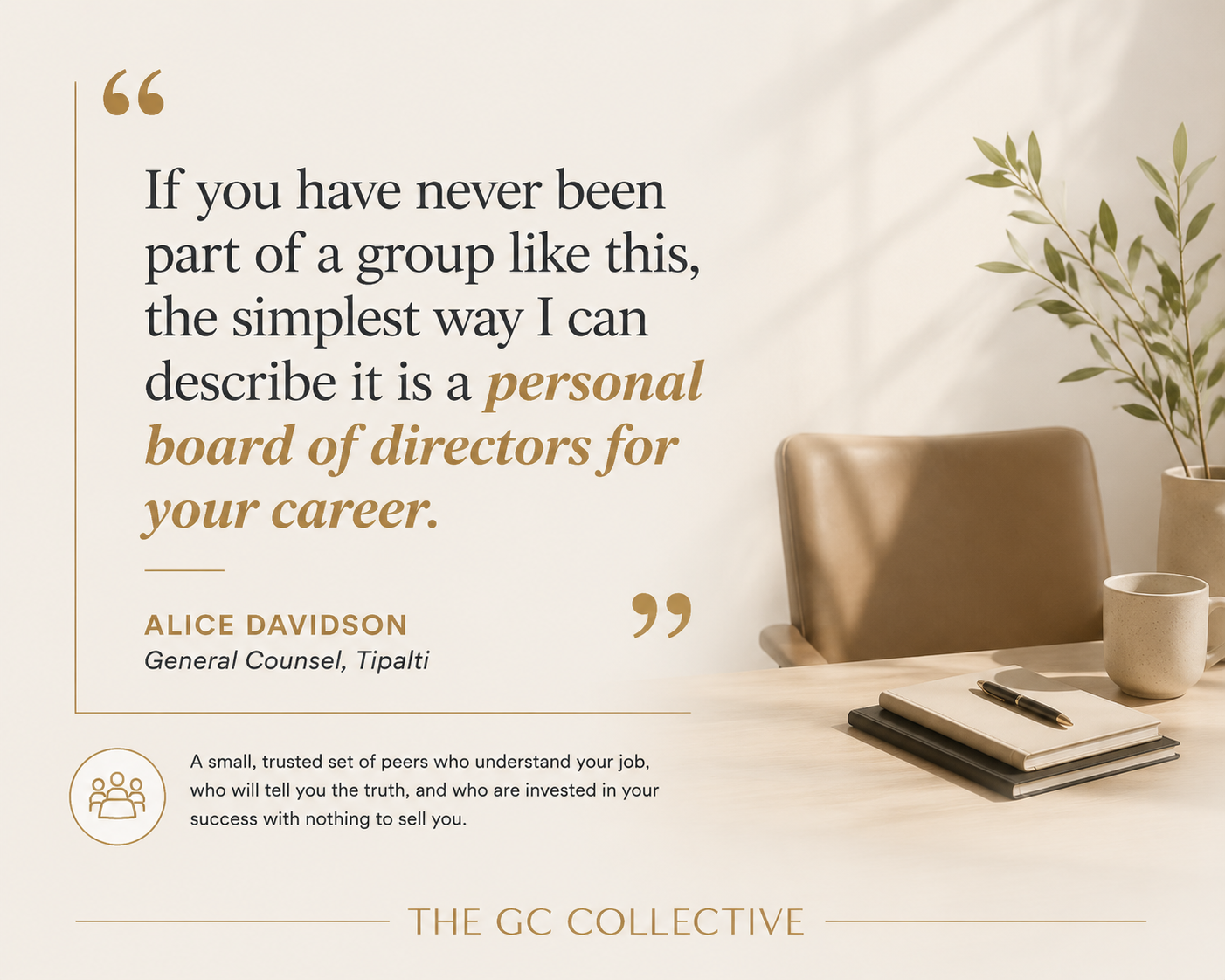
The experience is less like attending a course and more like having a personal advisory board - one that understands the unique demands of the GC role.
Alice Davidson, General Counsel at Tipalti, described it this way:
"If you have never been part of a group like this, the simplest way I can describe it is a personal board of directors for your career. It is a small, trusted set of peers who understand your job because they hold the same one, who will tell you the truth, and who are invested in your success with nothing to sell you."
It's difficult to imagine a stronger endorsement of what a peer advisory group can become.
The Value of a Trusted Circle
One of the themes we've heard consistently from participants is the value of having a confidential space where the conversation extends beyond legal issues to the broader realities of executive leadership.
Jeremy Chan, General Counsel & Corporate Secretary at Thinkific Labs, shared that the program gave him greater confidence and clarity to navigate complex stakeholder relationships and strengthen his leadership brand.
Fabien Fourmanoit, Chief Legal & Regulatory Officer at Beanfield, spoke about leaving every session with renewed enthusiasm and the reassurance that no matter how challenging the role becomes, he is no longer carrying it alone.
Those reflections speak to something larger than professional development. They speak to the confidence that comes from having a trusted group of peers who are invested in one another's success.
Why This Matters
The expectations placed on General Counsel continue to grow. Today's GCs are expected to lead people, influence business strategy, guide executive decision-making, and help organizations navigate increasing complexity. Technical legal expertise remains essential, but leadership is what defines long-term success in the role.
Like every other executive around the leadership table, GCs deserve trusted advisors who can challenge their thinking, broaden their perspective, and support them through the decisions that matter most.
Our next GC Executive Circle begins at the end of September, and applications are now open. Cohorts are intentionally limited to ensure meaningful discussion, confidentiality, and lasting relationships among participants. If you're looking for a trusted group of peers who understand the realities of leading in-house legal teams, we'd love to start a conversation.
